


21 Nov ART AS PROPAGANDA UNDER THE RESTORATION AND LOUIS PHILIPPE
The Bourbon restoration in 1814 and 1815 represented an existential crisis for the French – it heralded a period during which France was at peace (aside from a small diversion in Spain in 1823) but followed a time when even some of the most loyal adherents of the ancien regime had come to reluctantly admire Napoleon’s extraordinary military triumphs. France’s gradual decline in the face of an increasing powerful Great Britain during the eighteenth century had been briefly followed by a twenty-year period when France and its parvenu ruler dominated the European continent. Now her economy was in ruins and the country was only saved from total humiliation by the adept diplomacy of Charles-Maurice de Talleyrand, the aristocratic former Bishop, Foreign Minister to Napoleon, and architect of the restoration.
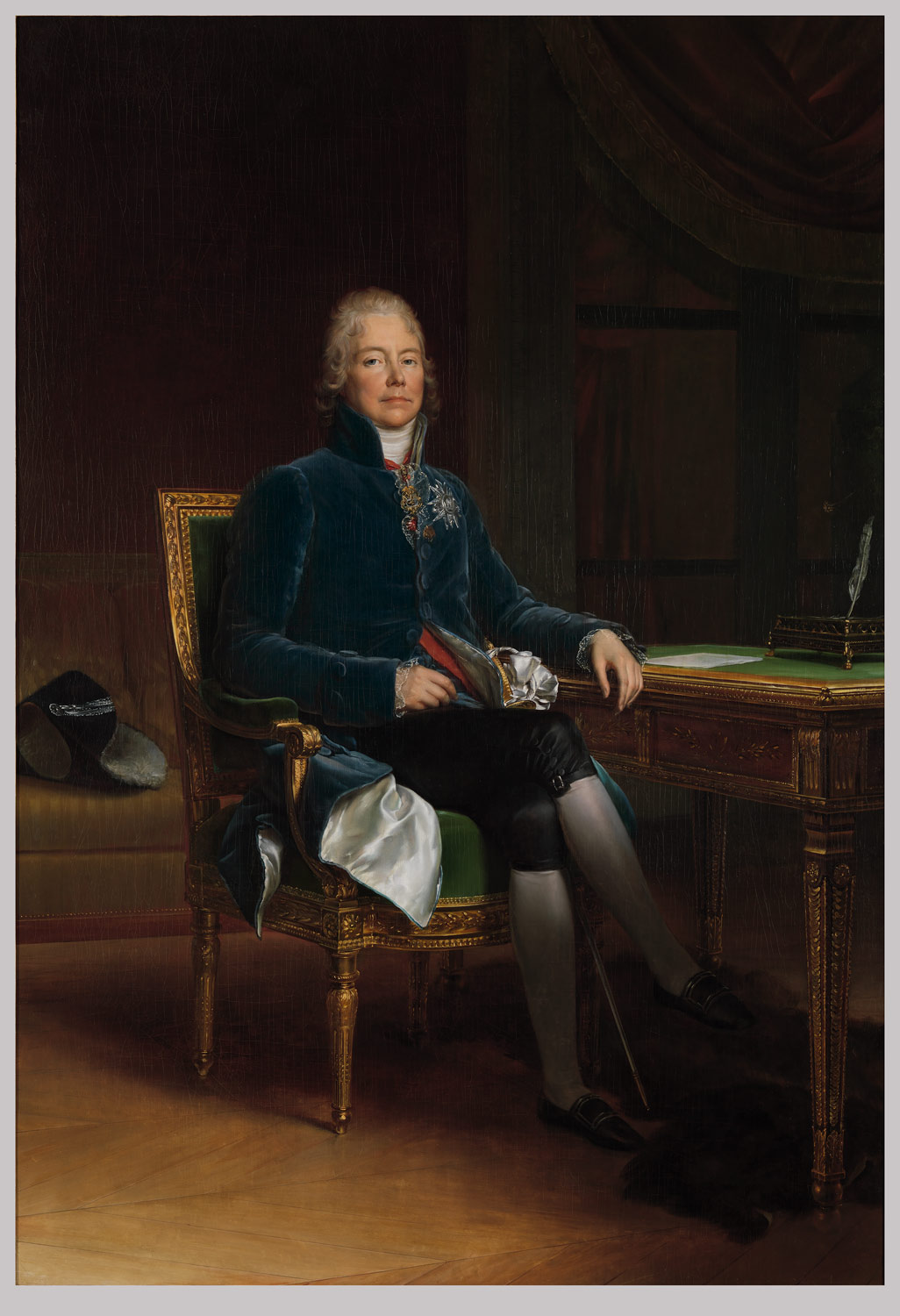
Baron Gerard, Charles Maurice Prince de Talleyrand in his Study, painted in 1808 (New York, Metropolitan Museum of Art, Wrightsman Gift).
The challenge faced by Louis XVIII was to rebuild loyalty to the crown and to this end official art was directed to emphasising the king’s descent from the first of the Bourbon monarchs, Henri IV, the most renowned of French kings in the popular imagination. Art was also used to popularise the royal family, emphasising concern for the less fortunate and, in the later 1820s, to burnish the image of the crown by presenting the young Duke of Bordeaux, grandson of Charles X, as the great hope for the future of the dynasty.

Mme Haudebourt-Lescot, The Generosity of the Duchess of Angouleme, Stair Sainty Gallery.
Our painting, the full composition sketch for Baron François Gérard’s vast canvas, Henri IV Entering Paris in 1594, which now hangs in Louis-Philippe’s “Galerie des Batailles” in Versailles, represents a deliberate attempt to parallel the end of the Wars of Religion that had divided France and, indeed, Northern Europe, in the sixteenth century, with the end of the Napoleonic Wars. This sketch had been specially commissioned by the king as he wanted to approve it before the artist began work – after requesting some minor changes he presented the painting to his niece, the Duchess of Berry.

Francois Buffet, Henri IV Receiving the Attributes of Monarchy from the Dying Henri III (exhibited at the Paris Salons, 1814 and 1817) sold by Stair Sainty Gallery
Following the death of Henri III, last of the male line of the Valois kings in 1589, Henri of Bourbon, King of Navarre (a throne he inherited from his mother), was the next heir according to the laws of male primogeniture which had dictated the French succession since Hugues Capet had founded the dynasty in 987 a.d. He was also the leader of the Protestant rebellion that had resulted in more than twenty years of bitter conflict and for many Frenchmen was unacceptable as their king. Henri III, dying from a wound inflicted by an assassin, confirmed that despite his religious affiliation Henri of Navarre was nonetheless the legitimate heir; the latter’s decision to convert to Catholicism while publishing a decree (the Edict of Nantes) which gave religious freedom to French Protestants, brought peace to the country. Tragically Henri IV, like his predecessor, also fell victim to an assassin in 1610, leaving a young son, Louis XIII, and another forty years of uneasy peace until Louis XIV was able to consolidate royal power.

Horace Vernet, The Duc de Chartres at the Place de Vendome, July 1830
When in 1830 Louis XVIII’s brother and heir, Charles X, was deposed in the July Revolution, the new King (“of the French”), Louis-Philippe, Duke of Orléans whose betrayal of his cousin lost him the support of much of the landed aristocracy, also needed to emphasise his royal descent from that same King. Hence his decision to include Gerard’s Henri IV Entering Paris among the paintings that were designed to glorify France’s military past in one monumental gallery. Aside from the capture of Yorktown Heights that marked the end of the American Revolutionary War, British visitors may not recognise the names of the several battles portrayed as French military triumphs over the English. For the government of Louis Philippe, however, paintings of these often minor engagements in which English, or later British troops were engaged, along with seven of Napoleon’s greatest victories on the continent, was intended regenerate a sense of national pride. Louis-Philippe’s hope that this great project would serve to buttress the claims to legitimacy of his own dynasty proved to be of little value when, like Charles X in 1830, he was forced into ignominious exile in the 1848 revolution.

The Galeries des Batailles, Palace and Chateau of Versailles