

Lévy-Dhurmer, Lucien
Algiers 1865 - Le Vésinet 1953
Biography & List of works
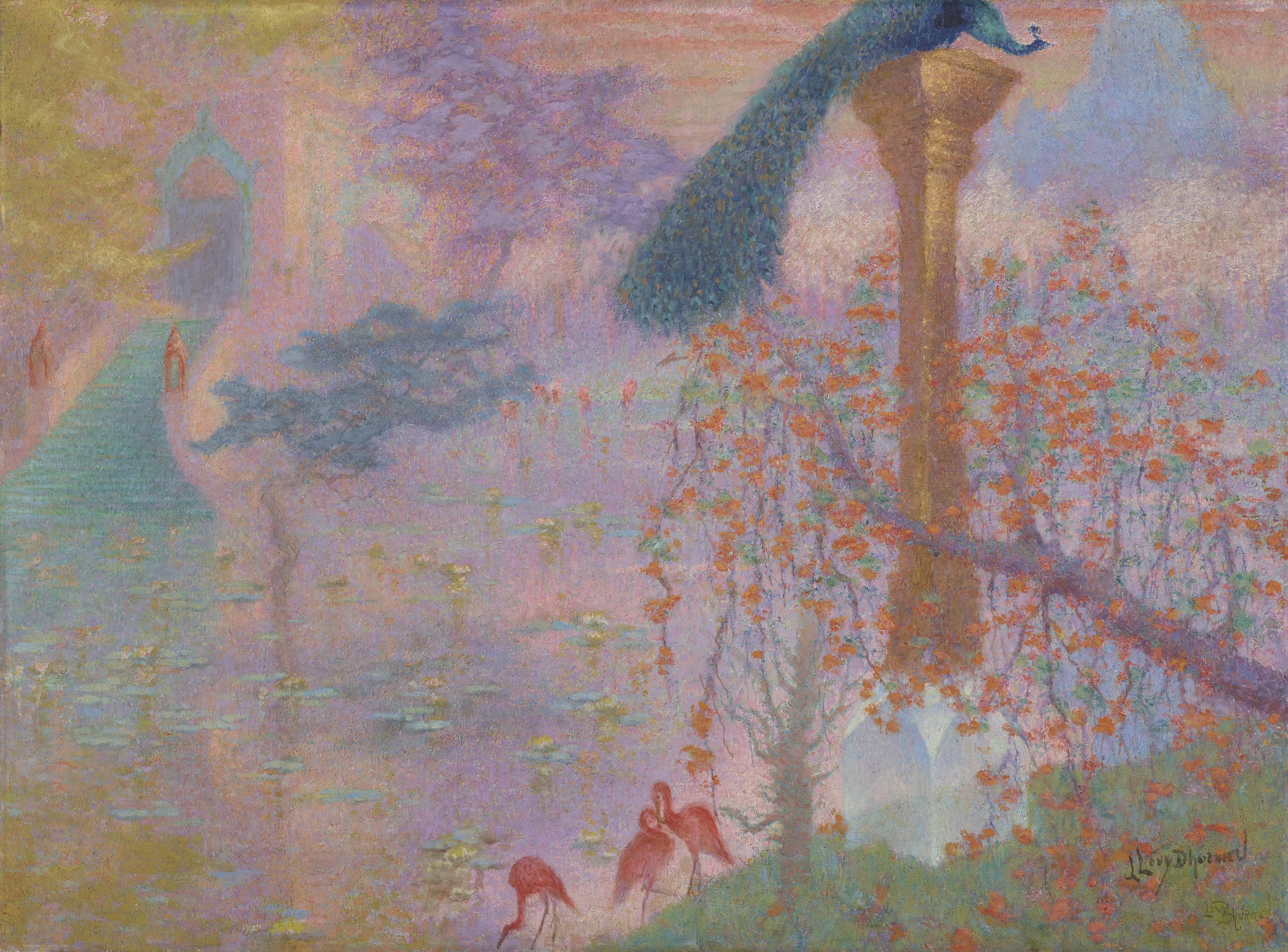
Scarlet Ibis and Peacock by a Lake with a Pavilion, c.1910
Year:
c.1910-1920
Medium:
Oil on canvas
Size:
60 x 81 cm / 23 ½ x 31 ¾ in
Signed:
Signed lower right: L Lévy-Dhurmer / Lévy Dhurmer
Provenance:
Collection Albert Oustric (banker to the Peugeot company), 1920-30; Private collection, France.
Lucien Lévy-Dhurmer was one of the leading figures of both the Symbolist and Art Nouveau movements around the turn of the last century. Throughout his long career, Lévy-Dhurmer constantly experimented with different artistic techniques, moving effortlessly between them in a way few artists could achieve. He was at once a ceramicist, painter, pastelist, and designer of furniture and interiors, proving himself to be a true ensemblier.
His attention to sources from the Far and Middle East, North Africa and Europe can be seen throughout his body of work and has included enchanting views of the Persian city of Ispahan, atmospheric landscapes of Venice and like here, stylised Far Eastern fantasies of temples, dancers and exotic birds. His famous Wisteria Dining Room, now preserved in the Metropolitan Museum of Art, is a brilliant example of the artist’s skill at designing a complete and harmonious environment by bringing together the many different media in which he could work.
Born in Algeria, his family returned to France in 1872 and in 1885 he graduated with honours, at the École communale supérieure de Dessin et Sculpture in Paris. Having been accepted as an exhibitor at the Paris Salon in 1882 (before he had even finished school) he continued to show there until 1889, when he suddenly departed the capital for the Côte d’Azur, abandoning a still promising career in Paris. In 1895, at almost thirty, he travelled to Italy where Venice and Florence particularly captivated him. This trip would cement a deep and life-long affinity to da Vinci and Italian Renaissance Art, as well as markedly re-focusing Lévy-Dhurmer on his earlier artistic aims and a return to painting almost abandoning his career as a ceramicist.
Sometime before October 1895 Lévy-Dhurmer relocated in Paris, and now painting full-time was invited by the Belgian poet George Rodenbach to his home to draw his portrait. (The portrait, made three years after the publication of Bruges-la-Morte, which made Rodenbach a symbolist literary icon, is today in the Musée d’Orsay, Paris). This friendship was no doubt the force behind Lévy-Dhurmer’s first solo exhibition early the following year at the Galerie George Petit.
The show at the Petit Gallery, of around twenty-five pastels and five paintings, instantly established Lévy-Dhurmer’s reputation in Paris. One critic exclaimed “a youth, a debutant and also a master,” asking rhetorically if the artist was “Symbolist, Mystic, or Romantic.” Another critic likened him to “da Vinci, Botticelli and Memling, the ancients, the moderns…” Lévy-Dhurmer continued working as a celebrated portraitist, draughtsman, pastelist and painter of religious, genre, symbolist and landscape paintings until the Second World War.
Large scale gallery shows were organized to celebrate Lévy-Dhurmer’s career in 1927, and again in 1937; upon the artist’s death in 1952 a retrospective exhibition was organized by the French Museums in Paris. More recently again, a further exhibition was organised by the Louvre at the Grand Palais in 1973, Autour de Lévy-Dhurmer, to celebrate the acquisition of a group of major pastels now hanging in the Musée d’Orsay.
Though primarily a solitary artist, Lévy-Dhurmer found commonality with the artists, writers, and musicians of the Symbolist movement, which formed to provide an intellectual alternative to the purely visual painting of the Impressionists. After 1900, Lévy-Dhurmer’s art explores the emotional and lyrical possibilities of landscape and atmosphere.